Last night I dreamed the ice broke. The river thundered, floes thrust upward, and green water pushed the pieces to the ocean’s edge where the breakers shredded them.
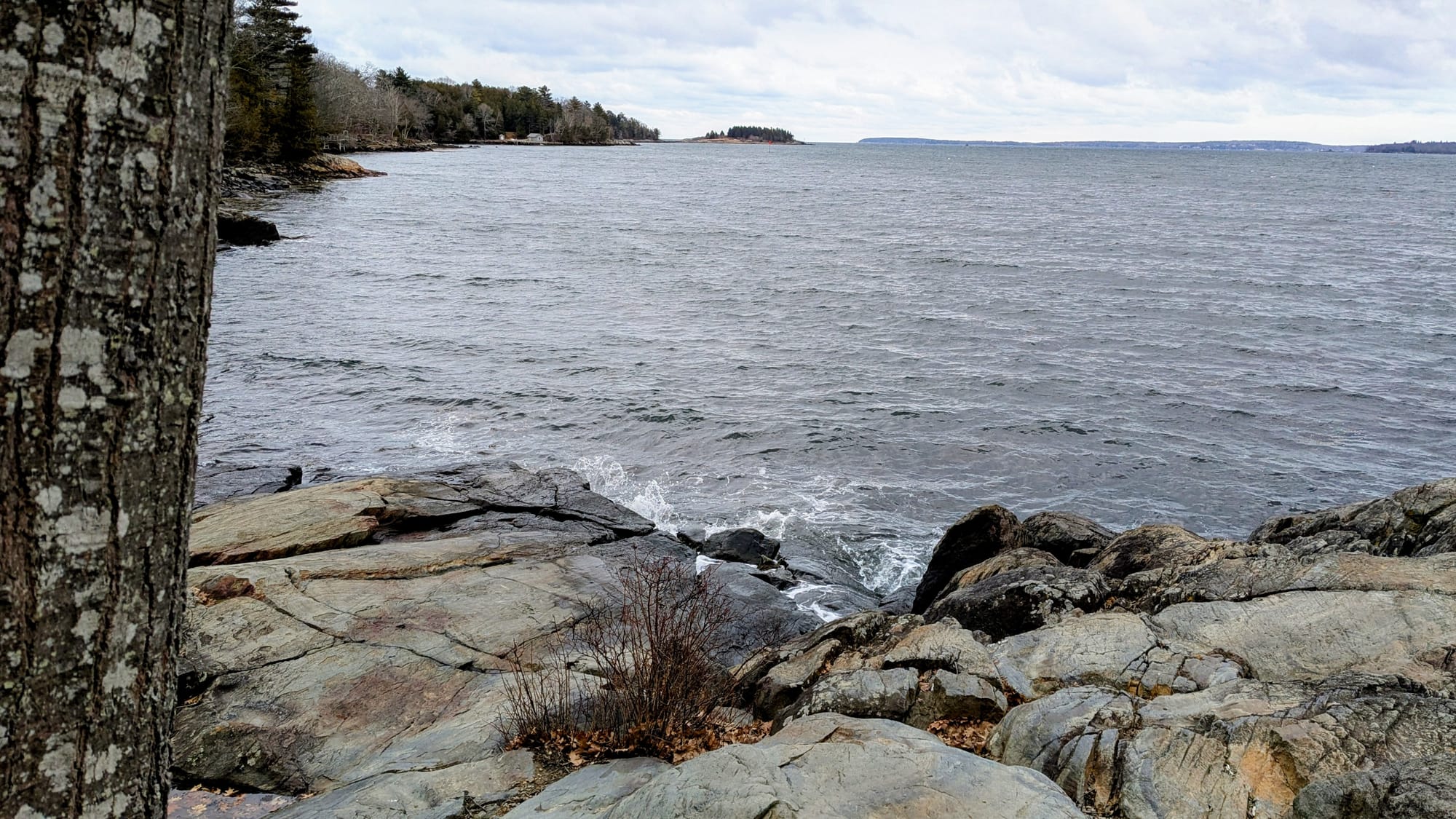
I woke up and went to the window. The river was glazed shiny with frozen rain and quiet. I watched waves hammer the solid prow of ice that jutted out of the river’s mouth into the salt water. There was sea smoke under the dull sky on the eastern horizon and below my window the snow on the concrete boat ramp that descended down the riverbank was a hard dirty white. There was no weakness in the freeze.
Kamara knocked at my door and I let him in. He wore a tweedy brown sport coat over a blue polyester shirt decorated with a tumbling pattern of displaying peacocks as if the birds had been thrown from a great height and were falling head over heels. I had not seen Kamara since my accident more than a year ago. I was sure he had come to talk about the car. Kamara does not visit anyone without a reason. I sold him my Plymouth Volare for five hundred dollars when I left the state university where we were roommates.
“It was very hard to find you,” Kamara said.
“Not hard enough.”
“You are always this way, Billy. Funny again.”
Kamara has a west African phrasing and oddly formal English pronunciation that at one time might have been part British, part French, part East Indian, but now was something else entirely. I have that Maine turn of phrase, which is mostly no phrasing at all. In Maine, I had told Kamara once, the first person to speak aloud at any gathering is considered the idiot.
“Is this your apartment, Billy?”
I looked around and didn’t answer. I went into the kitchen and put a pot of water on the stove.
“What happened to your head, Billy?”
The scar takes up the upper right part of my skull. I stepped into the bedroom and grabbed my damaged motorcycle helmet. I threw it to him.
“Thank Allah you were wearing a helmet,” he said.
Kamara was raised a Christian and had come to this country as part of a Catholic resettlement program, but he had forgotten that I knew that. Then he remembered.
“Allah or God, it makes no difference,” he said and made a sighing sound.
I poured hot water into a teapot containing two green tea bags. I watched the wall clock for four minutes, removed the bags, poured cups for both of us, and returned to making breakfast. Green tea is supposed to lessen my headache. I can’t tell if it works.
“I am having trouble with the brakes,” he said.
I nodded and turned the gas flame up under a pan of Canadian bacon.
“It will cost three hundred dollars to fix,” he said. “To say the truth, Billy, the first time I drove the car I felt the brakes with my foot and I thought, these do not feel right to me. But I trusted you.”
The trick with Canadian bacon is to heat it gently and evenly so the meat stays moist and the smoke flavor sweetens. I worked at this while Kamara continued explaining his feelings about buying a car from a friend. Nothing I could say would stop him. When he is in this mood, he wants hard evidence that he is understood. He is bargaining to win something tangible. He will not accept only words. He has plenty of words himself and considers them worthless.
“Billy, think on this, I have driven only a few hundred miles to and from work, and it was part time work, only a few days a week. And I am not driving to job interviews because no district is hiring vocational teachers now and I have not driven harmfully or done anything that could wear down the brakes so suddenly.”
I thought, what can I do for Kamara today? And as I have been taught in rehabilitation, I outlined the problem. How can I, a brain-damaged university trained actor, the son of an alcoholic father and a suicide mother, a man who is compelled to live in a rural areas and therefore has acted professionally only in disorganized community theater groups, help a state certified vocational arts teacher who saw his father and brothers killed by RU rebels and who has never held a job other than part time retail work and who has no hope of ever finding a position in a state with limited teaching jobs, and few vocations to teach, because he is completely impossible to deal with? And as I have been taught, I simplified the problem: there are two men, financial and personal failures, each living alone. There is a car with bad brakes. I removed the bacon from the pan and put it on a paper towel on a plate and put the plate in the warm oven.
“I understand how you feel,” I said, lying, because who knew how Kamara felt? Maybe someone who had also hidden in a latrine hole and watched their family butchered, but not me. “But Kamara, let me just say that I am having some problems as a result of my accident.”
“I am sorry to hear that, but…”
I held up one finger and he stopped.
“Kamara, we have talked many times about our cultural differences.”
His eyes burned with excitement. He wanted to tell me something about cultural differences and it frustrated him to have to wait for me to finish whatever nonsense I was going to say before he could speak.
“I have symptoms,” I said. “I have inappropriate emotional responses. A radio commercial can make me cry. I am not always able to tell memory from imagination. My dreams seem real to me and my decision making sucks incredibly. I have a loneliness and emptiness that immobilizes me.”
I was done. Kamara burst into words, they spouted out of him like a geyser. They were about cars and brakes and the proper buying and selling of large items such as cars and the cultural responsibility of the seller in all that buying and selling.
I scrambled eight eggs in the pan with butter. I placed them on a plate in the warm oven. I put on my jacket and walked outside. Kamara followed me, talking.
I opened the driver’s side door of the Plymouth and slid behind the steering wheel. I left the door open and made a show of stomping the brakes. After a moment, Kamara slid in the passenger seat, leaving his side door open. I gestured for the keys and he handed them to me. I put the keys in the ignition. I played with the emergency brake: pulled it off and then on and then off. I started the car. Kamara looked at me. I slammed the car into drive and accelerated forward. The car doors slammed shut. Kamara clawed at my right arm. Pounded at my head with balled fists. I drove down the boat ramp, bumped hard onto the ice, and roared out a hundred yards into the center of the frozen river.
I slammed on the brakes and the car spun a half-circle. I turned the car off. Kamara was holding the bottom of his seat with both hands. Some time passed.
I said, “The woman that hit me, she called to tell me she was sorry. She has nightmares about it. She wanted me to know about her nightmares. The accident was not my fault, but I feel like it was. Why am I like this, Kamara?”
He was silent, staring at the shore. I got out and stood on the ice. Kamara got out very slowly. He looked solemn. He took little skating steps toward the riverbank.
I walked up alongside him. Halfway to shore, he said, “Why would you do such a crazy thing, Billy? What is the matter with you?”
“That’s what I just asked you,” I said. “We’ll come back for the car later. We’ll drive to Bangor. I want to buy one of those peacock shirts.”
He pushed me. I ended up on my ass on the ice and I fell back with my arms outstretched. He laughed at me. I laughed back like an old roommate laughs, stupid with history. Then I felt the cold through my jeans.
I walked back to my apartment and Kamara followed. I served him breakfast at the table near the window with a view of the river. He dipped buttered toast in his scrambled eggs and drank tea. I ate sitting across from him, and for a moment I felt like crying, but as I have been taught, I controlled my emotions. The Plymouth looked handsome on the ice with its grill pointed upriver.
"A thrilling collection of voices."
Category: